On Monday, November 23, 2026, Iranian authorities carried out a sentence of 74 lashes against singer Parastoo Ahmadi and four members of her production team at the prosecutor's office in Qom. Ahmadi, 29, was flogged alongside Soheil Faghih-Nasiri, Amin Taheri, Amirali Pirnia, and Mohsen Lashkari. Their lawyer, Mostafa Nili, confirmed the sentences had been enforced after an appeals court upheld the verdict.
The “crime” was a concert. In December 2024, Ahmadi released a 27-minute performance filmed at the historic Deir-e Gachin Caravanserai near Qom — a concert with no live audience, made only for the camera and released on her YouTube channel. She sang solo, without the mandatory hijab, in a long black sleeveless dress, accompanied by male musicians. The video drew millions of views. Among the songs was “Az Khoon-e Javanan-e Vatan” — “From the Blood of the Youth of the Homeland” — a patriotic anthem from Iran's Constitutional Revolution era.
“I, Parastoo, the girl who wants to sing for the people I love,” she wrote when she released the concert. “This is a right I couldn't overlook — singing for the land I deeply adore.”
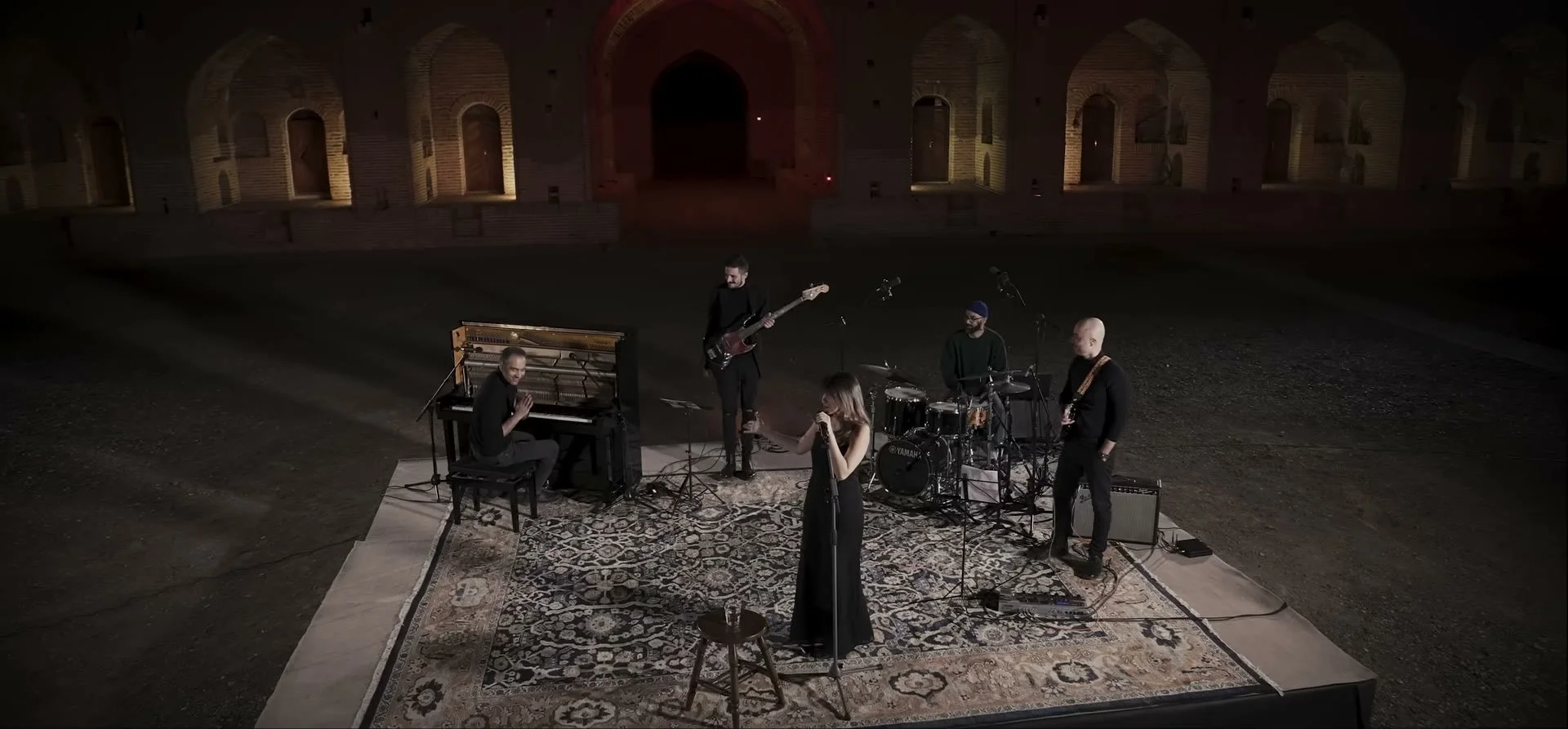
A Voice They Tried to Silence
The concert was not Ahmadi’s first act of defiance. During the 2022 Woman, Life, Freedom protests, she performed “Az Khoon-e Javanan-e Vatan,” a song of mourning for the young people killed. In June 2023, she released “The Air of Freedom”; months later, a judicial case was filed against her, she was summoned to Tehran’s Security Court, and her belongings were confiscated. Days after the Caravanserai Concert appeared online in December 2024, she was arrested in Mazandaran Province, along with two of her musicians, and released on bail days later after public outrage.
The Sentence
In June 2026, Branch 122 of the Qom Criminal Court II convicted Ahmadi and eight members of her production team of “offending public decency by producing and publishing obscene and immoral content online.” Each was sentenced to 74 lashes, a two-year ban on all artistic and musical activity, and a two-year travel ban. The court called the performance “obscene and vulgar.” At the end of September 2026, an appeals court in Qom upheld the verdict, making the sentence final and enforceable.
The World Responded
Days before the sentence was carried out, Amnesty International called on the Iranian authorities to halt the flogging, condemning the punishment as torture. The celebrated musician Hossein Alizadeh offered to take the lashes in her place. Exiled singer Googoosh spoke out for her. None of it stopped the sentence.
Singing Is Not a Crime
Flogging is torture under international law, and Iran’s use of it against women who refuse the hijab is not new: in January 2024, activist Roya Heshmati was flogged 74 times for a photograph of herself without a headscarf. But Ahmadi’s case carries its own message — the regime did not punish a protest or a slogan. It punished a song. A woman, alone on a stage built from history, singing of the blood of the country’s youth, her hair uncovered, her voice unaccompanied by permission.
The concert is still on YouTube. Millions have watched it. No number of lashes can un-sing it.
