Harsh Judicial Retaliation in the Wake of the 2026 Uprising
Engineering of Terror within the Context of Gender Apartheid
Recent protest movements, particularly the 2026 uprising, targeted the Achilles’ heel of the power structure: the pioneering role and leadership of women. In response to this fundamental shock, the security and judicial apparatuses have launched a broader wave of systematic suppression of women in Iran by unprecedentedly escalating and accelerating past repressive tools. This aggressive strategy possesses a multi-layered structure. On one hand, the Revolutionary Courts seek political retaliation and the suffocating of society’s voice by issuing death sentences for political and protesting women. On the other hand, the execution machine within the ordinary crimes sector targets female victims of social harms; ranging from child brides and domestic violence victims who acted in self-defense by killing their spouses, to destitute and impoverished women who, under the influence of smuggling rings affiliated with powerful institutions, fall victim to the gallows on drug-related charges. Through these parallel arms, the regime has equipped public intimidation with the harshest judicial mechanisms.
Today, the frontline of defiance against this onslaught is active within the women’s wings of prisons, where women’s resistance fuels the most authoritative anti-execution campaigns. In this article, we dissect the blatant dimensions of the systematic suppression of women in Iran by analyzing the following axes: the threat of death sentences being carried out against protesting and political women, the surge in execution statistics of women on ordinary charges in 2026, the critical condition of female political prisoners under pressure, the intensified pressures aimed at breaking the “No to Execution Tuesdays” campaign, and finally, the targeted escalation of the suppression machine against religious dissidents, specifically Baha’i women.
The Judicial Raid of the Revolutionary Courts; Women Standing Under the Shadow of Death Sentences
The security and judicial apparatus of the Islamic Republic utilizes a collection of death sentences issued prior to the uprising, as well as the cases of post-2026 uprising detainees, as a tool for public intimidation to break the will of women who have been at the forefront of social transformations. Documented review of ongoing cases reveals that the judiciary, relying on abstract charges such as “armed rebellion” and “enmity against God” in the Revolutionary Courts, practically uses the death penalty as an arm of suppression and political retaliation against political and protesting women—both regarding previously issued sentences and in the process of issuing new ones.
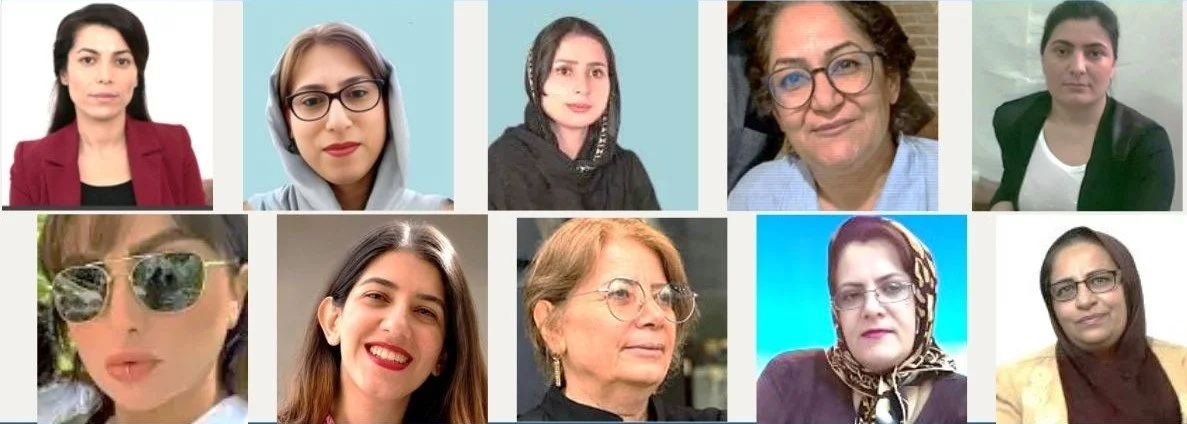
At the helm of this manufactured process stand the names of judges such as Iman Afshari (Head of Branch 26 of the Tehran Revolutionary Court) and Abolghassem Salavati (Head of Branch 15), acting as the primary agents of this execution machine. The issuance of a death sentence in April 2026 for Maryam Hadavand based on forced confessions under torture and without the presence of a chosen lawyer, alongside the sentence issued for Zahra Shahbaz Tabari, a 67-year-old citizen, in a 10-minute trial held in absentia via video-conference (presided over by Judge Ahmad Darvish Goftar on October 25, 2025), represent the most blatant examples of judicial terror. The regime has even equated civil medical and relief aid, such as Mahboubeh Shabani assisting wounded protesters with a motorcycle in Mashhad, with the charge of Moharebeh to maximize the scope of public intimidation.
